

Recreation therapy helps veterans rebuild life after injury
How recreation therapy moved one veteran from ‘just survive’ to a future full of possibility
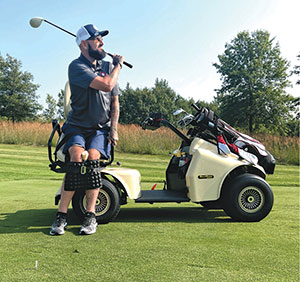
When he was in the Army, Justin Hall sometimes tripped and fell.
He brushed it off as clumsiness.
Then his left leg started going numb and his back began hurting. Doctors, including a neurologist, attributed the symptoms to an old rib injury.
He left the Army in 2010 without any further explanation.
He developed insomnia and leg spasms. He had no response on a nerve conduction study. Still, no diagnosis.
Hall lived with these symptoms for years, pushing through the pain.
In 2019, he went on a surfing trip to Hawaii, which was “the most fun thing in the world,” he said. Six months later, he had a major autoimmune response.
Hall’s body shut down.
He fell into a two-week coma, and when he woke up at the Medical University of South Carolina (MUSC) in Charleston, he was completely paralyzed.
“I had to blink to communicate,” Hall said.
Another neurologist looked over his records and made the diagnosis that had eluded other doctors for years: autoimmune glial fibrillary acidic protein (GFAP) astrocytopathy—a condition where the immune system mistakenly attacks support cells in the brain and spinal cord. The condition was rare enough that it hadn’t been formally described until 2016.
While in Charleston, Hall said he didn’t think much about the diagnosis or the possibility of being paralyzed for the rest of his life. Instead, he remembers replaying in his mind the scene from Quentin Tarantino’s film “Kill Bill” where Uma Thurman’s character, the Bride, repeats, “Wiggle your big toe,” willing herself free of her own paralysis.
‘Survive right now’
Hall made some progress during his month-and-a-half stay at MUSC, regaining the ability to make small movements—turning his neck slightly, squeezing his hand. Then he learned he was being moved to the Department of Veterans Affairs hospital in Augusta, Georgia.
“I was really scared to come to the VA, because I didn’t have good luck with the VA system,” Hall said. “I cried when they told me they were transferring me.
“And then I got here, and it was, like, the best therapy ever.”
Two days after admission to the Charlie Norwood VA Medical Center’s intensive care unit, Hall was moved to the spinal cord injury unit. Work started in the gym, where therapists moved his limbs. Then he asked to use the therapy pool.
“And that’s when I could barely move my arms, so I had to prove that I wouldn’t drown,” Hall said.
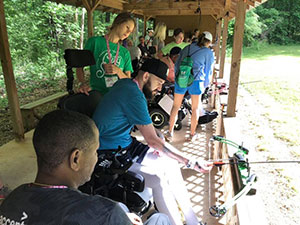
Weeks after arriving, he went with other spinal cord injury inpatients to an overnight camp experience at Georgia’s Fort Yargo State Park—his first exposure to adaptive sports such as zip lining and archery. He saw them as just distractions from his condition.
“I wasn’t even thinking about the possibilities of life when I was at that camp,” Hall said. “I was very much in a ‘just survive right now’ mode. Being told I had this disease, I thought it was a death sentence. I didn’t think I would live past five years.”
Giving life
But recreation would become far more than a distraction for Hall—a revelation he credits to his recreational therapist, Suzanne Kenrick.
“I was a very depressed person,” Hall said. “I feel like Suzanne saw that and was like, ‘Hey, have you thought about just getting out there and being active?’”
Kenrick, who’s been with Augusta’s spinal cord injury unit since 2002, said rec therapy takes activities a person enjoys and uses them to facilitate function.
“I tell my veterans this many, many times: There’s life beyond your spinal cord injury,” Kenrick said. “Our goal is to give back [a veteran’s] purpose and help them find what that is.”
Rec therapy often gets attention because of adaptive sports clinics like the annual winter sports and golf clinics that DAV co-presents with the VA. Kenrick said veterans who participate in those events only represent about 1% to 2% of all veterans she sees.
Rec therapy encompasses much more, Kenrick said, finding what brings a person joy—whether it’s sports, gardening, painting or something else.
“We’re able to take one person at a time and just get down to ‘What is it that makes you tick?’” she said.
For Hall, it’s sports—especially pickleball—thanks to Kenrick’s invitation to the gym where she hosts weekly games for veterans using wheelchairs.
Beyond the hospital walls
“The first time I showed up to pickleball, I was so nervous because I didn’t know anybody there except for Suzanne,” Hall said, “and everybody there had been in sport chairs for a decade or more.”
By the end of that day, he was spinning the ball and winning shots.
“This is my very first time doing this, and I’m giving somebody a little bit of an issue,” he recalled thinking. “I can’t move in this chair, but maybe one day I could.”
He kept playing and improving, and instead of seeing it as a distraction, he saw potential.
Those weekly matches are also where he met Dr. Lisa Maddox—someone he considers a mentor.
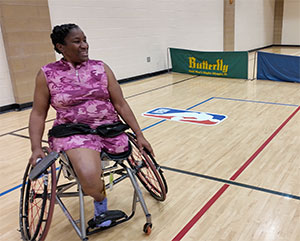
Maddox, an Army veteran, former VA physiatrist and above-the-knee amputee, was a nationally ranked wheelchair tennis player and is deadly on the pickleball court. She offers a perspective both as a patient and as a doctor who worked closely with rec therapists.
Maddox recalled one patient under her care—a Black woman veteran—who just wanted to get her hair done after being in a hospital bed for a while.
“Black women’s hair is a lot different than Black men’s hair and other races, because our hair isn’t straight and it’s challenging,” Maddox said.
Maddox worked with her team to have part of the veteran’s rec therapy include getting her hair done.
“She was just so thankful,” she said. “And that really showed me the absolute worth and power of rec therapy.”
Where physical therapy and occupational therapy help with strength and daily tasks, rec therapy brings it all together to help a veteran navigate the world after an injury—getting a haircut, opening doors, shopping for groceries and dining out.
“We would take our chairs and just go out in public,” Hall said. “Simple stuff, but it’s not so simple anymore.”
“They’re not approaching the world on two feet, necessarily, anymore,” Kenrick said. “They don’t live within the four walls of the hospital here, so it’s important to make that jump into the community. To me, that’s the greatest impact we have.”
Kenrick said that to facilitate rec therapy, the VA will fund adaptations to equipment but not the item itself. For example, the VA won’t buy a kayak, but it will buy outriggers. Sports chairs, like those used to play pickleball or basketball, are considered VA-fundable adaptations, which Kenrick said can be preventive medicine.
“Being an active participant in your life and feeling like you have purpose makes you want to stay well,” she said. “That $5,000 chair may seem expensive up front, but every day that a veteran stays out of the hospital and stays more well, then the burden of care on the medical system is less and less.”
By paying for adaptations, the VA is the healthcare outlier—most civilian insurance companies will use a “medical necessity” standard to deny those requests.
‘Endless possibilities’
Advocates for rec therapy, including DAV, continue to remind lawmakers of its beneficial role in veterans’ lives, backing bills that would expand veterans’ access. In February, several people testified before the Senate Committee on Veterans’ Affairs about how adaptive sports and recreation therapy have been critical in their care journeys.
“The conclusion that a lot of folks made was ‘well, we just need more rec therapists,’” said Kenrick, who watched the hearing. “And I was like, ‘Yes, hallelujah!’ because there are way more veterans than there are of us.”
DAV National Legislative Director Jon Retzer’s statement for the record for that hearing noted that recreational pursuits are a key component of physical rehabilitation, mental health recovery and social reintegration.
“They are clinically recognized tools that improve mobility, reduce isolation and restore confidence,” he wrote.
Rec therapy, Hall said, helped renew his outlook on life.
“I used to think that life was over, that there were no possibilities, and now it’s like they’re endless,” Hall said. “Life is full of possibilities where I thought there were none.”
He got married last year and wants to start a family. He wants to compete. He also wants to be a mentor—like others were to him—to veterans coming through the spinal cord injury unit in Augusta.
Wheeling his chair into the unit’s pool room one recent morning, he saw a veteran who was newer to the unit and in the early stages of his recovery. With a smile on his face, Hall started a conversation.
“How’s it going?”

Related Content
Bill would secure justice for veterans of Cold War-era human experiments
DAV-backed OATH Act would secure justice for veterans of covert Cold War-era human experiments
A morning walk, a Purple Heart, a debt paid
A daily stroll led to life-changing benefits for a Marine’s unrecognized wounds from Vietnam
New watch takes the helm: Members chart DAV’s future at the 2026 national convention
New national commander takes the helm as DAV members unite at 2026 national convention and shape the year ahead
