
The modern covenant
As the U.S. entered World War I, Congress realized the 19th-century veteran pension model was financially unsustainable. In response, it passed the War Risk Insurance Act, shifting to a modern model of purchased policies and vocational rehabilitation.
However, this shift created a bureaucratic nightmare. By 1920, returning Doughboys with mustard gas-scarred lungs were trapped between three uncoordinated agencies: the Bureau of War Risk Insurance held the money, the Public Health Service had the doctors, and the Federal Board for Vocational Education managed the training. This bureaucratic fragmentation could lead a veteran to suffocate in a hospital bed with zero income while agencies argued over paperwork.
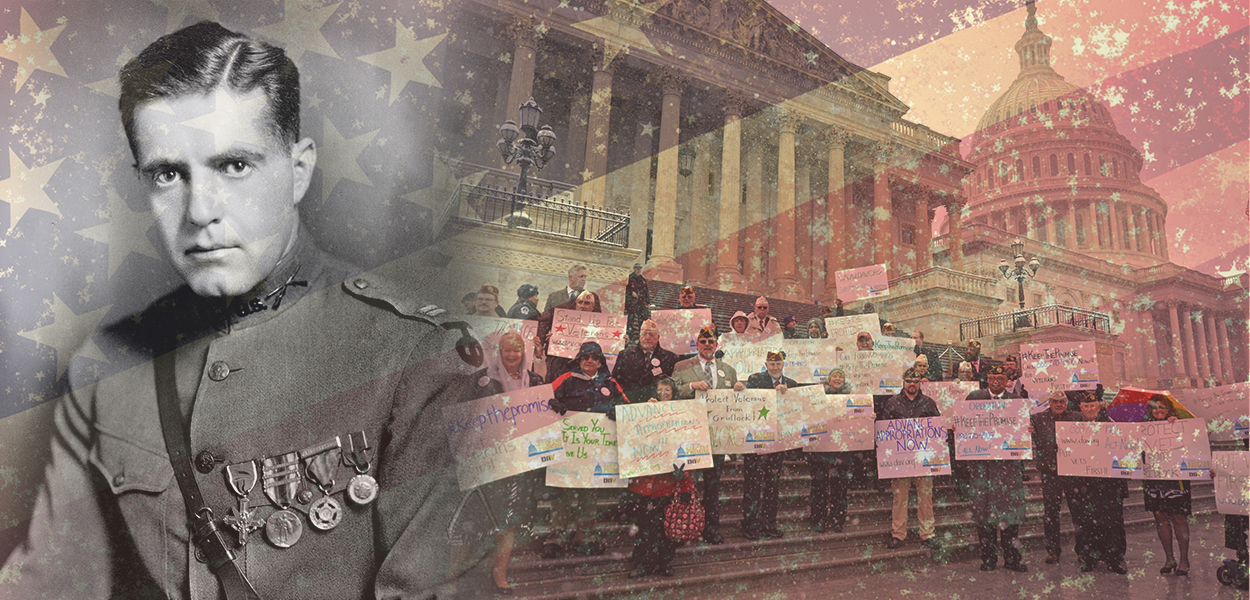
Into this chaos stepped Judge Robert S. Marx, a severely wounded World War I Army veteran who saw that scattered administration was costing lives. On Christmas Day 1919, Marx organized a gathering of disabled veterans, and on Sept. 25, 1920, Disabled American Veterans of the World War, DAV’s original name, was established.
In June 1921, DAV held its first national convention, and the mandate was clear: consolidation. Marx essentially put the government on trial for negligence, documenting cases of veterans who had died waiting for paperwork to move offices.
This advocacy led to the Sweet Act, which merged the competing agencies into a single Veterans Bureau, decentralized power, and established presumptive periods for tuberculosis and what was then called shell shock. Known as “DAV’s Baby,” the Sweet Act was the organization’s first, but not last, major victory.
The Bonus Army and the ‘Tombstone Bonus’
Economic gratitude proved fickle. To bridge the gap between low wartime military pay and high domestic wages, Congress passed the World War Adjusted Compensation Act. Instead of cash, veterans received Adjusted Service Certificates that wouldn’t mature until 1945. President Calvin Coolidge vetoed the bill, famously stating, “Patriotism which is bought and paid for is not patriotism,” though Congress overrode him.
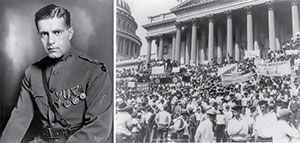
By 1932, the Great Depression left veterans with these certificates as their only collateral, but they wouldn’t be able to cash them in for over a decade. In response, an unemployed former Army sergeant named Walter W. Waters organized a march from Portland, Oregon, to Washington, D.C. The ranks of protesters swelled as 43,000 veterans and families joined in, crossing the nation before setting up camp near the Capitol. The Bonus Army, as it would be called, maintained strict military order in its cardboard shantytowns to prove they weren’t bums, according to Roger Daniels in his book, “The Bonus March: An Episode of the Great Depression.”
While the camps occupied the mudflats, DAV acted as the respectable arm of the protest.
“By the summer of 1932, DAV was uniquely positioned to act,” said DAV National Adjutant Barry Jesinoski. “We had just been granted our federal charter by Congress, officially recognizing us as the voice for disabled veterans. For our members, that bonus wasn’t a windfall or a luxury—it was a life raft.”
DAV handed Congress a critique of legislation that told veterans to wait 13 more years for immediate relief. “We called it the ‘Tombstone Bonus,’ because it was scheduled for 1945, a date many of our members wouldn’t live to see,” Jesinoski said.
The standoff between Waters’ Bonus Army and the federal government ended in violence that July. Army Gen. Douglas MacArthur ignored presidential orders, crossed the river and treated the eviction of starving veterans like a military conquest, burning Bonus City to the ground. Army Maj. George S. Patton led a cavalry charge with drawn sabers while Army Maj. Dwight D. Eisenhower mapped the advance as soldiers used vomiting agents near families.
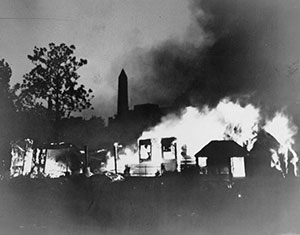
Watching the smoke rise, then-presidential candidate Franklin D. Roosevelt reportedly remarked, “This elects me.” Yet, after his election, FDR’s Economy Act of 1933 slashed veterans benefits by 25% overnight, placing the idea of government solvency above the moral debt owed to those who bled.
DAV launched a massive nationwide telegram campaign, flooding Congress with stories of severely disabled veterans whose compensation was slashed. On March 28, 1934, Congress defied the president and overrode FDR’s veto to restore the cut benefits, proving the veteran lobby was a permanent political force. By 1936, another sophisticated DAV outreach blitz forced the early payout of the World War I bonuses, injecting $1.5 billion into the mid-Depression economy.
World War II and the Era of the Shrinking Promise
As the nation got closer to World War II, the government abandoned its pay-later approach for a security-from-day-one contract, highlighted by the National Service Life Insurance Act of 1940. These hard-learned lessons culminated in the first GI Bill, replacing “Baby Bonds” with transformative investments in education and housing.
In 1943, DAV championed the Disabled Veterans Rehabilitation Act. Then-National Commander Laurence Melton understood that while a pension facilitates survival, rehabilitation facilitates life. By 1947, veterans accounted for 49% of all college admissions, and 16 million veterans traded foxholes for the suburbs. However, these prosperity gains were unevenly distributed, as systemic barriers often denied Black and other minority veterans access to these classrooms and neighborhoods.
The Cold War ushered in the era of the shrinking promise. From 1950 to 1979, the government debated whether peacetime or Cold War service merited superpower investment. The Veterans’ Readjustment Assistance Act of 1952 downgraded benefits, forcing Korean War veterans to manage flat monthly stipends for tuition and rent rather than paying schools directly.
DAV became a barrier between the veteran and a congressional pair of scissors. Then-Legislative Director Cicero Hogan called out the irony by arguing, “It is an astonishing irony that the government will freely appropriate billions of dollars to build a better tank yet turn right around and try to save pennies on the care and rehabilitation of the flesh-and-blood soldier who was broken driving it.”
When President Gerald Ford vetoed the Vietnam Era Veterans’ Readjustment Assistance Act of 1974—weeks after pardoning Richard Nixon and offering clemency to draft evaders—DAV led a fierce backlash with a stinging narrative: mercy for the deserter, but a veto for the veteran. Congress delivered a swift, surgical override.

By the late 1970s, the unpopular Veterans’ Educational Assistance Program replaced the original GI Bill. To rescue cratering military recruitment, Rep. G.V. “Sonny” Montgomery and Army Gen. Max Thurman fought for three years to establish and finalize the permanent Montgomery GI Bill by 1987.
The late 1980s transformed veterans rights from gratuities into legal entitlements. The Department of Veterans Affairs Act of 1988 elevated the VA to a Cabinet-level department. At the same time, the Veterans’ Judicial Review Act of 1988 dismantled a century-old system where the VA acted as its own investigator, judge and jury, creating the U.S. Court of Appeals for Veterans Claims and allowing professional legal representation.
Subsequent landmark legislation in 1984, 1991 and 1998 shifted the burden of proof away from the individual by establishing the first presumptives for radiation, Agent Orange and Gulf War Syndrome.
The New Century of Advocacy
Since 9/11, public perception has shifted from viewing veterans through a broken lens to recognizing them as civic assets. Modern advocacy has focused on long-overlooked corners of the community:
- The Isakson-Roe Omnibus (2020): Expanded education benefits and established the VA Advisory Committee on Tribal and Indian Affairs; later added pandemic-era protections.
- The Deborah Sampson Act (2021): Made historic investments in women veterans by expanding healthcare, including ensuring dedicated women’s health providers at every VA medical center and retrofitting community-based outpatient clinics for privacy and dignity.
- The PACT Act (2022): Significantly expanded recognition of toxic exposures, including burn pits, establishing presumptive service connection for numerous cancers and respiratory illnesses.
- The Elizabeth Dole Act (2025): Increased the cap on home-based care from 65% to 100% of nursing home costs, enabling more veterans to age with dignity in their own homes.
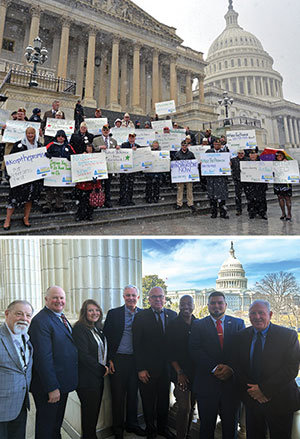
“Beyond policy drafting, we mobilized our DAV CAN (Commander’s Action Network) to provide the political pressure needed to get these bills across the finish line,” said National Legislative Director Jon Retzer. During the final push for the Dole Act in late 2024, DAV members sent thousands of messages to Congress that made a critical difference.
Despite these historic wins, critical pieces of legislation like the Major Richard Star Act, the Housing Unhoused Disabled Veterans Act, Veteran ACCESS Act, Student Veteran Benefit Restoration Act, and VA Vocational Readiness and Employment Reforms all remain stalled amid ongoing procedural budget debates in Congress.
President Calvin Coolidge is often credited with warning, “The nation which forgets its defenders will be itself forgotten.” Veterans benefits are more than just line items in a budget; they’re a declaration of a society’s memory.
To join DAV CAN and ensure your voice is heard on Capitol Hill, visit davcan.org.

Related Content
Bill would secure justice for veterans of Cold War-era human experiments
DAV-backed OATH Act would secure justice for veterans of covert Cold War-era human experiments

A morning walk, a Purple Heart, a debt paid
A daily stroll led to life-changing benefits for a Marine’s unrecognized wounds from Vietnam

Recreation therapy helps veterans rebuild life after injury
How recreation therapy moved one veteran from ‘just survive’ to a future full of possibility
New watch takes the helm: Members chart DAV’s future at the 2026 national convention
New national commander takes the helm as DAV members unite at 2026 national convention and shape the year ahead